Our Heritage

History of the Tide Mill Dam

Three centuries of tides, millstones, fire, and rebuilding at the head of Southport Harbor

Where the Mill River meets Southport Harbor, a small rocky island has been tied to the tides for more than three hundred years. Early settlers called it Herdsman’s Island, probably because the town’s sheep were gathered there each night, safe from wolves. In 1697 the town of Fairfield gave permission to build a grist mill there. The mills that followed, the dam, and the tidal pond behind it have shaped this corner of Southport ever since.

This is their story, told from town records, newspaper accounts, a curator’s research, and the photographs that survive — in the order it happened. The building itself is a rarity: the Tide Mill Institute pictures it among ten tide mill buildings still standing in the northeastern United States. None still operate.

How a Tide Mill Works

A tide mill needs no waterfall. It borrows the power of the sea, twice a day.

The flood tide fills the pond

As the tide rises in the harbor, gates in the dam let salt water flow in and fill the mill pond. At flood stage the tide can reach about a mile up the Mill River.

The gates hold it back

At high tide the gates close, trapping the water in the pond — a tidal basin that stays high while the harbor outside begins to fall.

The ebb turns the mill

When the tide has fallen about halfway, the gates open and the trapped water rushes out, turning the machinery that drives the millstones until low tide or shortly after.

“It was a tide mill and could only operate on the falling tide. When there was a lot of grain to be ground, Mr. Kelsey would get up in the nite, light his old oil lantern, start the mill agoing to catch the falling tide.” — William O. Burr, remembering miller Alva Kelsey in 1951

Part One

A River of Mills

Fairfield began as a farming community — and farmers needed millers.

1639

A farming town needs a miller

Fairfield is founded in 1639. Farmers depend on millers to grind their wheat, and land is even granted to millers to encourage them to settle. In time the shores of the river are dotted with grist, fulling, and sawmills.

1640s

How the river got its name

Elizabeth Hubbell Schenck’s 1889 history of Fairfield says the first grist mill on this river was built upstream at Mill Plain by Thomas Sherwood, in the mid-1640s. John Green soon added another above it.

“…hence the name of Sasqua was changed to that of the Mill river.” Elizabeth Hubbell Schenck, The History of Fairfield, 1889

1662

Mills multiply on the Mill River

In 1662 Richard Ogden completes a mill for the town on the Mill River, with its own dam and trench, upstream at Mill Plain, where Perry’s Mill later stood. For the next fifty years, the town’s records are full of grants of privileges to build more grist mills and fulling mills along the river.

Millers were paid in grain: a share of what they ground, usually one sixteenth, called the toll. Until Ogden’s mill is finished, the town lets Thomas Sherwood, miller of “the new mill on Mill river,” keep the toll.

1697

A mill on Herdsman’s Island

At a town meeting in Fairfield, Thomas Bedient asks for liberty to build a grist mill on the Mill River “at ye place called Herdsmans Island.” The little island at the head of Southport Harbor had been named by the early settlers, probably because the town’s sheep flock was herded there each night, to keep them safe from wolves and other predators.

It is the earliest grant for a mill on the island found in records.

Permission is not proof. The Fairfield Historical Society’s curator cautions that we do not know whether the mills permitted here in 1697, 1702, and 1722 were actually built, “but it is likely they were.” By 1770 a mill definitely stood on the island.

Part Two

Fire, War, and Rebuilding

Wooden mills burn. On the Mill River, they were rebuilt again and again.

1702

Consumed by fire

Town records of August 6, 1702, as quoted in a 1997 article, report that the mill on the Mill River had been “consumed by fire” and that there was a “necessity of a mill being erected again for ye comfort” of the town. Permission to rebuild on Herdsman’s Island is given to Moses Dimon and Joseph Perry — Perry then a young man of about twenty-five. The passage quoted does not say which mill had burned.

A second fire, in 1705, was upstream: Richard Ogden’s mill at Mill Plain burned that year, and Joseph Perry bought the site and built the dam at what became Perry’s Mill.

1720

The town authorizes a dam

In town minutes of December 1720, the town grants Joseph Perry the old mill pond and gives him liberty to erect a grist mill at Herdsman’s Island, “where it may be most convenient for making a damm over the river near that place.” The curator of the Fairfield Historical Society dates Perry’s permission to build on the island to 1722, and the National Register of Historic Places records this as the site of a grist mill from around 1722.

It is the earliest permission for a dam here that we have found. The dam standing today, with its concrete spillways, is later; we have not found when it was built.

Sources differ on the date: a restaurant brochure gives 1712, the town-minutes notes 1720, and the curator and National Register 1722.

1770

“It grinds well”

Peter Perry, who runs a mill a mile upstream, writes in his account book that Jabez Perry’s new mill on Herdsman’s Island threatens to take away a good deal of his business.

“…for it is the talk that it grinds well.” Peter Perry’s account book, 1770

1779

The Revolution reaches the Mill River

In July 1779 British troops burn Fairfield, and the next day land at Mill River, where they burn “eight houses and out-buildings.” Later local accounts say the tide mill burned too, but other accounts of the raid do not mention it.

The danger does not end. On March 4, 1781, William Wheeler of Black Rock notes in his journal that the enemy, thirty men in four boats, “burnt 2 tide mills on Mill River belonging to the Perrys.”

An account from the other side survives as well. Captain Hubbell of the Associated Loyalists, crossing from Long Island, landed with thirty to forty men in whaleboats and led a party up the river.

“…two miles up Mill River & destroyed two mills & about two hundred barrels of flour, collected there, as they were told, for the French at Rhode Island.” Account quoted in Elizabeth Hubbell Schenck, The History of Fairfield, vol. 2, 1905

After the war, Jabez Perry rebuilds again.

Was this mill one of the two? Wheeler’s “tide mills” points to this stretch of the river; “two miles up” better fits Perry’s Mill, farther upstream. We cannot be certain.

1800

New owners, a famous view

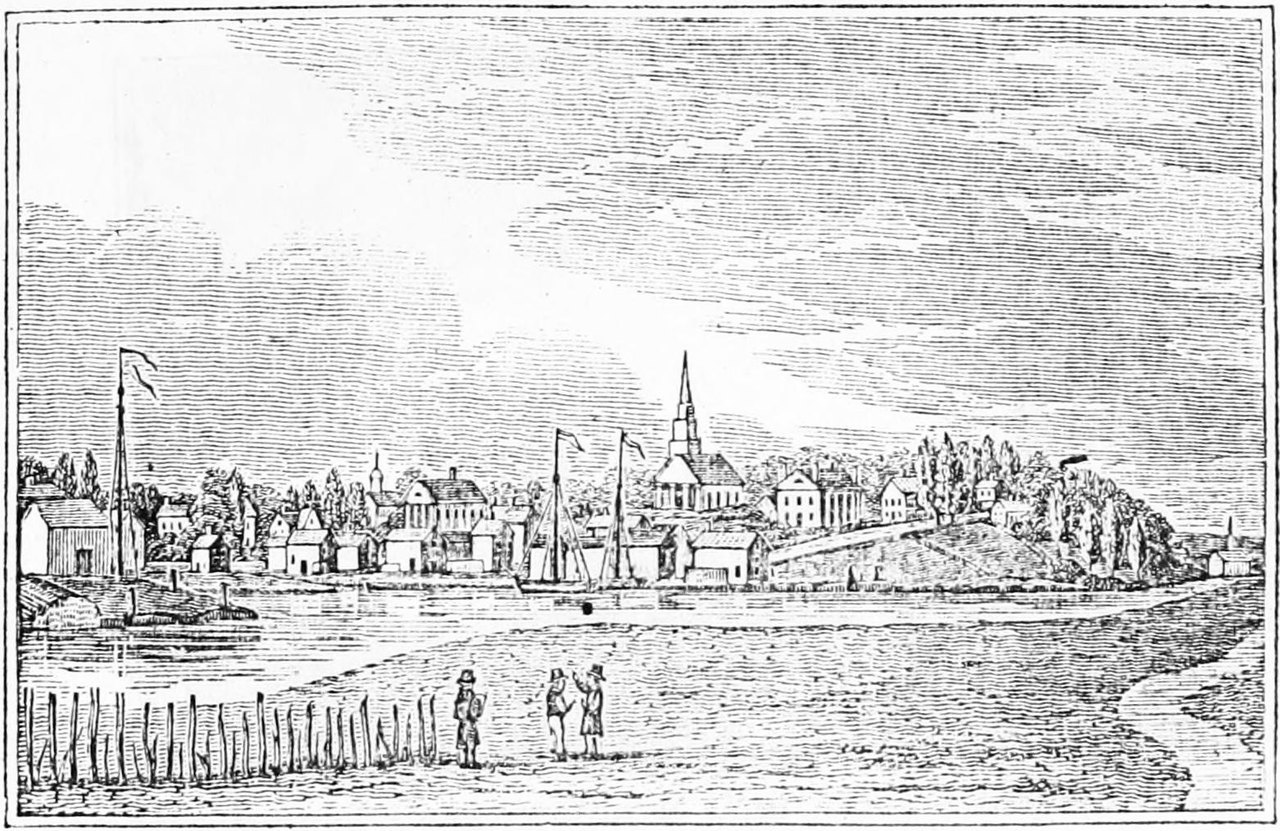
The mill leaves the Perry family in the early 1800s and is owned by Enoch and Charles Foot, and later by John Moody, who also runs a mill on the Rooster River near Bridgeport. It is a simple two-story rectangular building, set across the island at a right angle to the water’s flow. The curator finds it in the right background of John Warner Barber’s famous 1836 view of Southport Harbor.

1836 engraving of Southport seen across the harbor, with a church spire, waterfront buildings, sailing vessels, and a small building at the far right edge
“South view of the Borough of Southport, Fairfield,” from John Warner Barber’s Connecticut Historical Collections, 1836. The building in question is at the far right edge.

Barber himself describes the building at the far right as a flour mill “situated on the New York turnpike, about one fourth of a mile from the village.” It may be the tide mill, but his location does not quite match.

1831

Southport grows up around the harbor

As shipping and trade boom, the area between the harbor, the Mill River, and Sasco Creek is made a separate borough and named Southport. According to the National Register nomination, more shipping was owned in Southport, in proportion to its size, than in any other port between Boston and New York — a claim Barber made in 1836. Farmers here turn to onions — the “Southport onion” — and sailing vessels carry the harvest to New York. When the railroad arrives in 1848–49, reliance on shipping by water drops sharply, and the borough is dissolved in 1854 — though the name has stayed.

Part Three

The Working Mill

The building that stands today, and the last miller to run it.

1854– 1855

Another fire, and a missing mill

In 1854 Aaron B. Gould sells a “tract of land or mill site and mill dam and pond, with liberty to build and repair said mill dam” — with no mention of any mill standing on it. Tradition says the old mill burned around 1855. A map of Southport made in 1858 shows no mill building on the island at all.

1860s

A new mill, probably Alva Hough’s

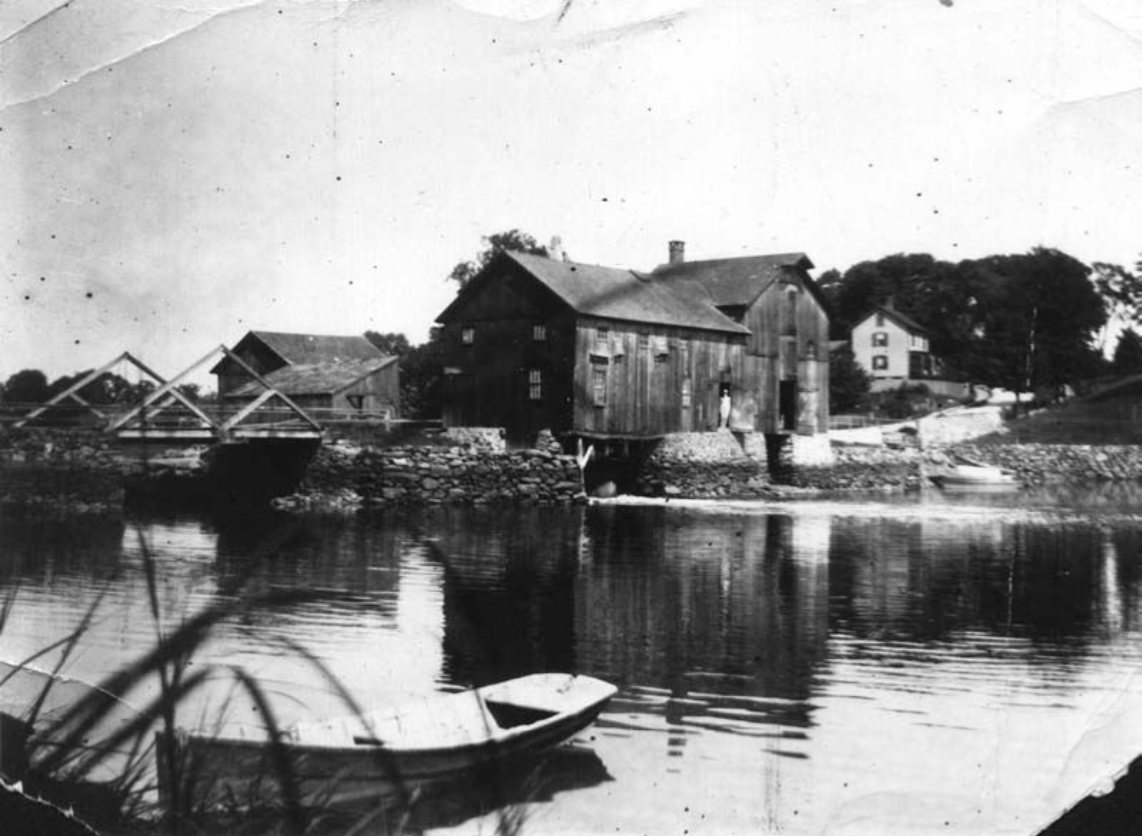
Sometime between 1854 and 1866, a new mill goes up on the island. The curator thinks it likely that Alva Hough built it, during the Civil War years. It is a large two-and-a-half-story building in two wings — one set perpendicular to the river, one parallel to it — sheathed in plain vertical boards. A big barn door opens onto Harbor Road so wagons can be loaded and unloaded; three doors, one above another, on the south side let grain and flour be loaded and unloaded from boats. Two chimney stacks rise from the roof, probably outlets for drying kilns.

Instead of a classic waterwheel, the new mill is driven by a turbine under the west wing. Water flows in through gates in the east dam on the rising tide, is held in the mill pond, then released through a sluiceway on the west side once the tide has dropped far enough to free the turbine. The turbine spins a shaft that rotates the millstones.

Black-and-white photograph of the wooden Tide Mill from the southeast, beside a truss bridge, with a rowboat in the foreground
The mill from the southeast, around 1900: two wings of weathered vertical boards on a stone-lined foundation at the water’s edge, beside the truss bridge.
1870August 31

“Try to Please”

Francis Jelliff buys the mill property from Eli B. Nichols and advertises his new business in the Southport Chronicle as “Southport Mills” — flour, feed, and grain, with free delivery.

“Every article sold warranted to be the best of its kind, and all at the lowest cash prices… Our motto is — Try to Please.” Francis Jelliff, No. 10 Water Street, Southport

1880s

Sturges and Kelsey

In the 1880s the mill is bought by Frederick Sturges, a wealthy New York merchant and financier whose summer home is on Mill Plain in Fairfield. Alva R. Kelsey, a miller who came here from Clinton around 1879, is already at work, and he will run the mill for nearly forty years. (The curator’s account points to 1881; other notes say 1888.)

Local farmers, working small plots of tired soil, can no longer compete with flour from the Western grain fields. The mill’s days as a business are numbered — but Sturges keeps it grinding anyway, as a public service to the few Fairfield farmers still hanging on.

1893

The island on the map

An atlas map of Southport published in 1893 shows the island as a small oval in the middle of the Mill River, with the road crossing the river at that point, as it does today.

1906

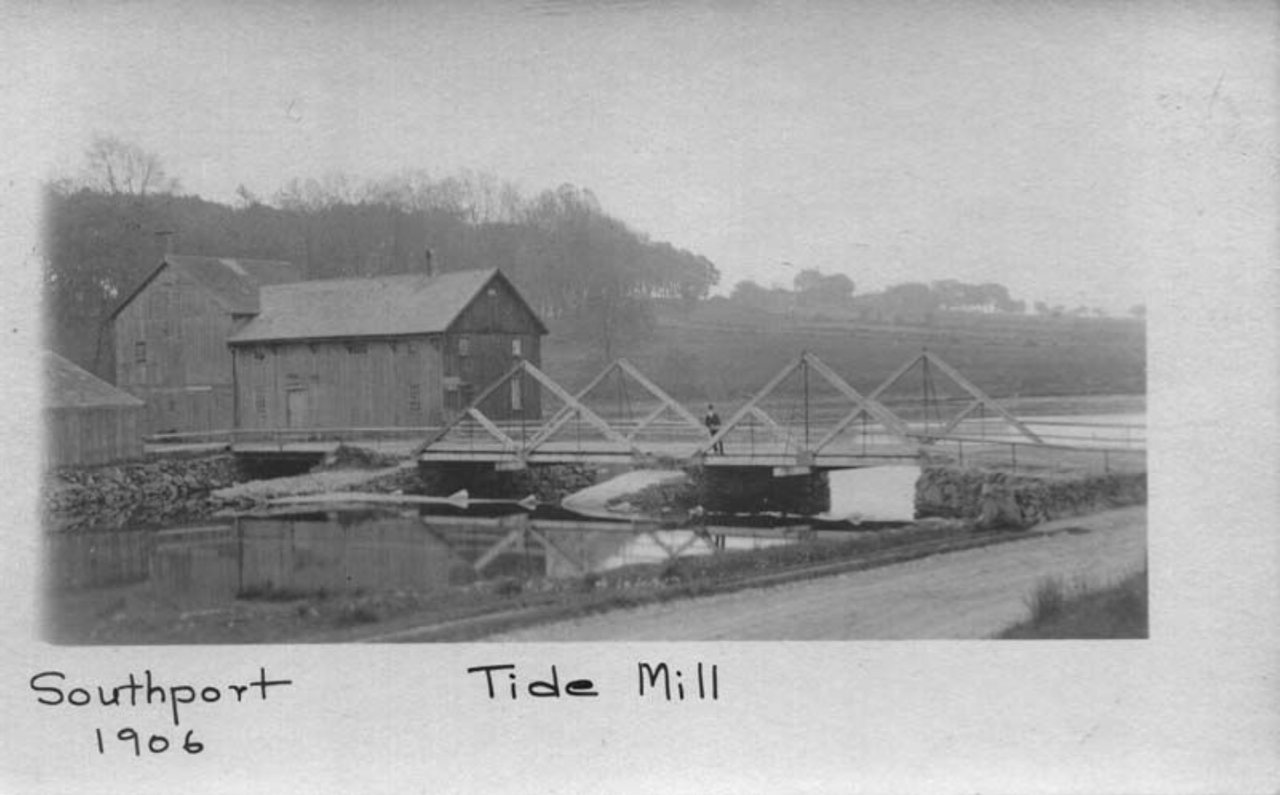
A postcard of the mill

Photographic postcard captioned Southport Tide Mill 1906, showing the mill buildings and a truss bridge over the river
“Southport Tide Mill, 1906” — the handwritten caption on a photographic postcard. The truss bridge crosses the river beside the mill.
1916October 15

“Still Grinds Its Daily Grist”

The Hartford Daily Courant devotes a full feature to the Fairfield tide mill, calling it “probably the only mill of its kind still in operation in this part of the country,” at work for about two hundred years. No one, it adds, can say when a mill was first built here. Once, the writer notes, many tide mills dotted the Sound shore; now most had been dismantled or stood silent.

Alva Kelsey, the 75-year-old miller, had spent half his life at the mill. Of three sets of machinery once kept busy, only one still ran, mostly cracking corn for poultry. The wheat stones had gone silent as “new process” flour from the Northwest won over households, and the war in Europe cut off the imported bolting cloth needed to sift flour. William O. Burr later remembered Kelsey as “a great miller” whose rye flour was the finest and whose bolted cornmeal was the best — a man who could take out the great millstones and sharpen them himself when they stopped grinding fast enough.

“Were the Fairfield mill dependent upon its earnings to keep it in operation, probably it, too, would long since have ceased its whirring.” Hartford Daily Courant, October 15, 1916 — on Frederick Sturges’s support of the mill

The article also describes the dam itself.

“The little river, just as it reaches the head of the harbor, encounters a dam, in which are a series of gates which swing inward, the top of the gates being a little higher than the high-water mark.” Hartford Daily Courant, October 15, 1916

Local children came to the mill to fish and crab. Miss Regina Kiley of Bridgeport, one of the last to remember it in operation, recalled being taught to bait a hook and crab by Kelsey — and the shock of first seeing him emerge from the mill covered from head to toe in white flour dust. He looked, the curator wrote, exactly as she thought a ghost should look.
1917– 1918

The wheels stop

Frederick Sturges dies in December 1917, and by 1918 the mill has stopped grinding. Alva Kelsey moves away to Guilford. The tide no longer turns millstones on Herdsman’s Island. (A later restaurant brochure puts the last grinding in 1915.)

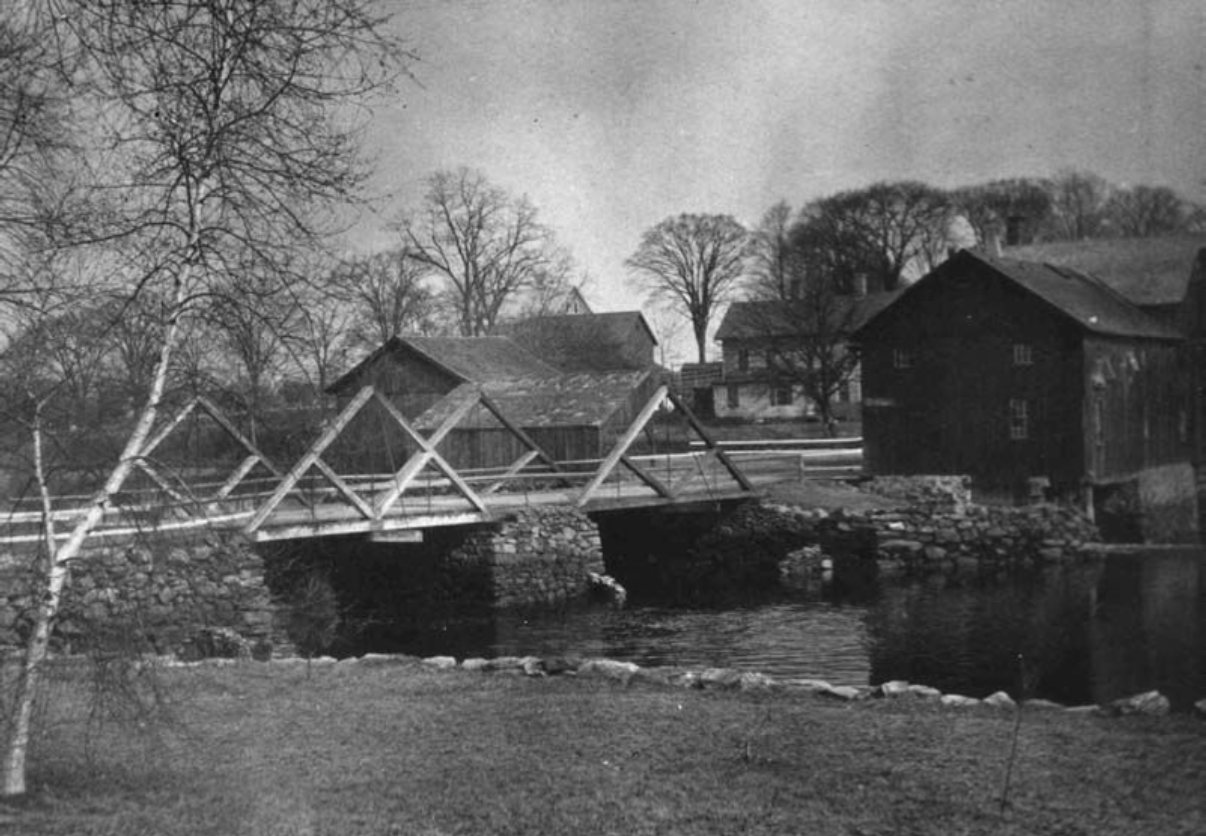
Black-and-white photograph of the Tide Mill and its truss bridge over the river, seen through bare trees
The mill and its truss bridge around 1918, in the last years of grinding.

Part Four

Tavern and Inn

The mill finds a second life — as a place to eat, with a view.

1924

The Tide Mill Tavern

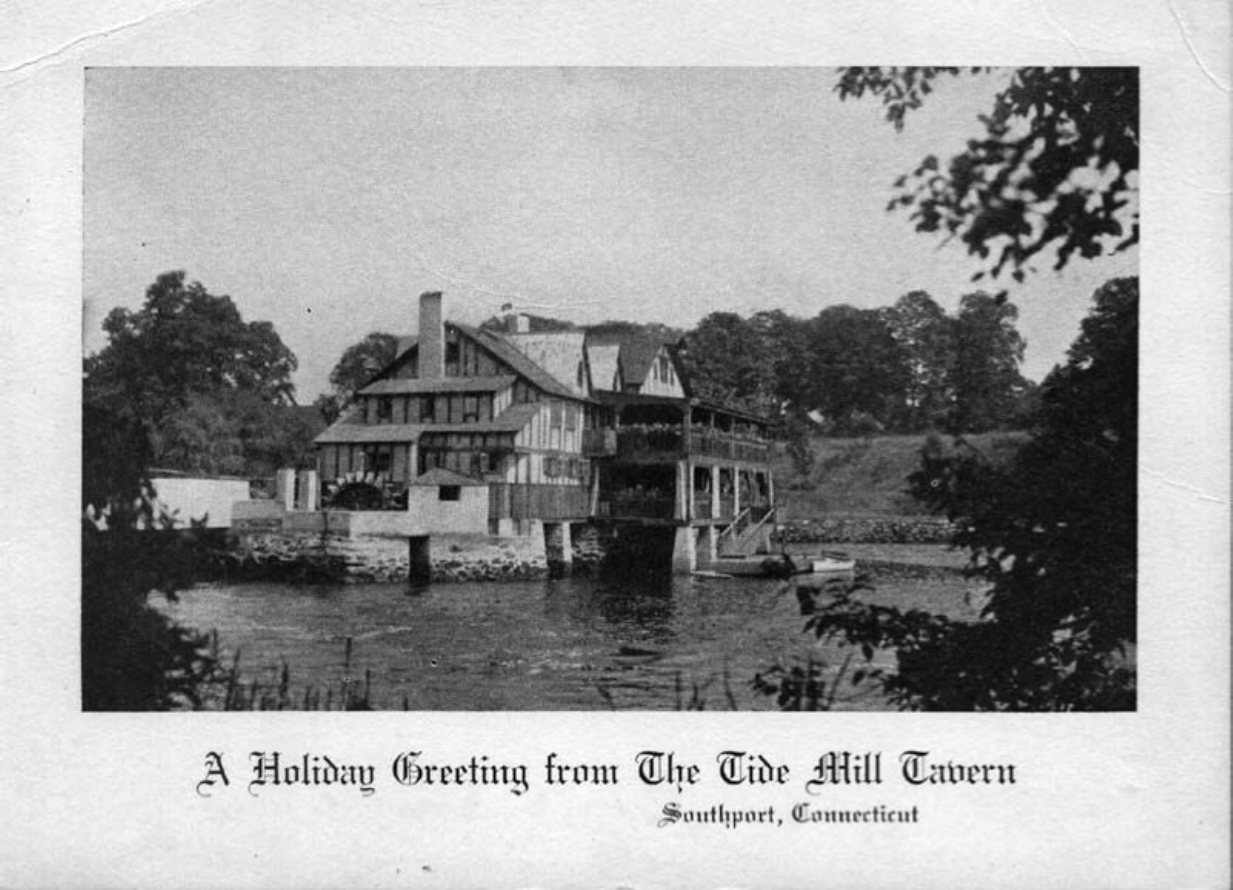
Clarence B. Sturges, a developer of the estate district on Sasco Hill and, according to the curator, a founder of the Country Club of Fairfield, buys the mill from Frederick Sturges’s estate, intending to preserve it as a reminder of Fairfield’s earlier days. He gives the exterior a half-timbered Tudor look, with bay windows and peaked dormers, adds a two-story open porch overlooking the harbor, and installs a stage-set waterwheel on the west side. Inside, the rustic mill interior is decorated with nautical antiques and paintings.

The Tide Mill Tavern opens in 1924 (the brochure says 1927) under the management of Margaret S. Taylor — a pleasant place for the growing suburban population to stop on a drive along the shore. There is a dock for passing pleasure craft, and overnight guests can be put up in the upstairs rooms.

Holiday greeting card from the Tide Mill Tavern, Southport, showing the half-timbered building and its porch over the water
“A Holiday Greeting from The Tide Mill Tavern,” 1920s. The waterwheel at left was added for atmosphere; the old mill now wears a Tudor coat.

For years, the tavern’s owners tried and failed to win a liquor license. It didn’t stop the yachting crowd: they would anchor alongside, drink their martinis aboard while waving at the diners, and then come ashore for dinner.

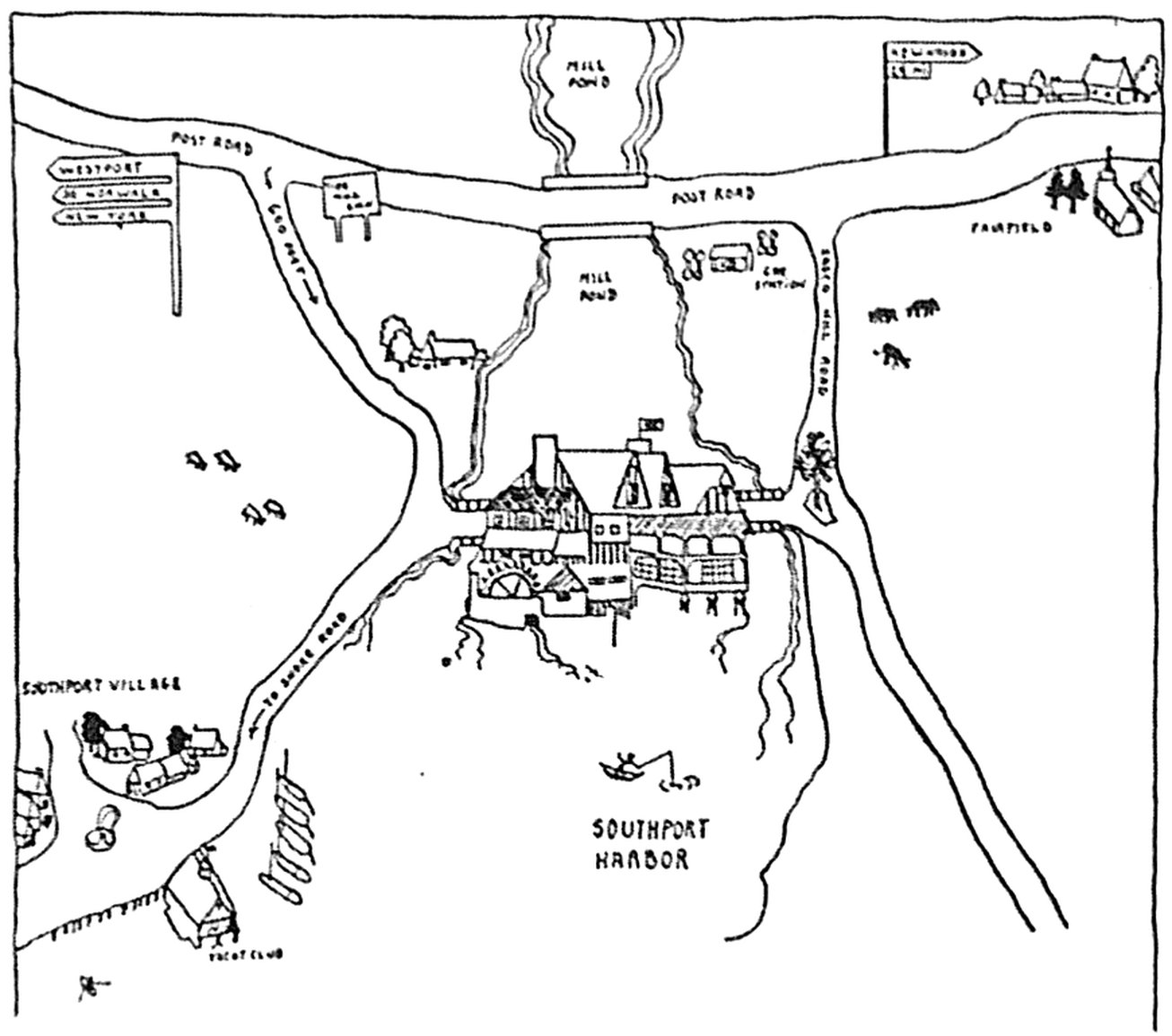
Hand-drawn map of the island between the mill pond and Southport Harbor, with the Tide Mill Tavern on it, the Post Road above, Southport Village at left, and sheep grazing in the fields on either side
A hand-drawn map from a Tide Mill Tavern advertisement, marked 1939. The tavern sits on the old Herdsman’s Island between the mill pond and Southport Harbor, with sheep still grazing in the fields nearby.
1942

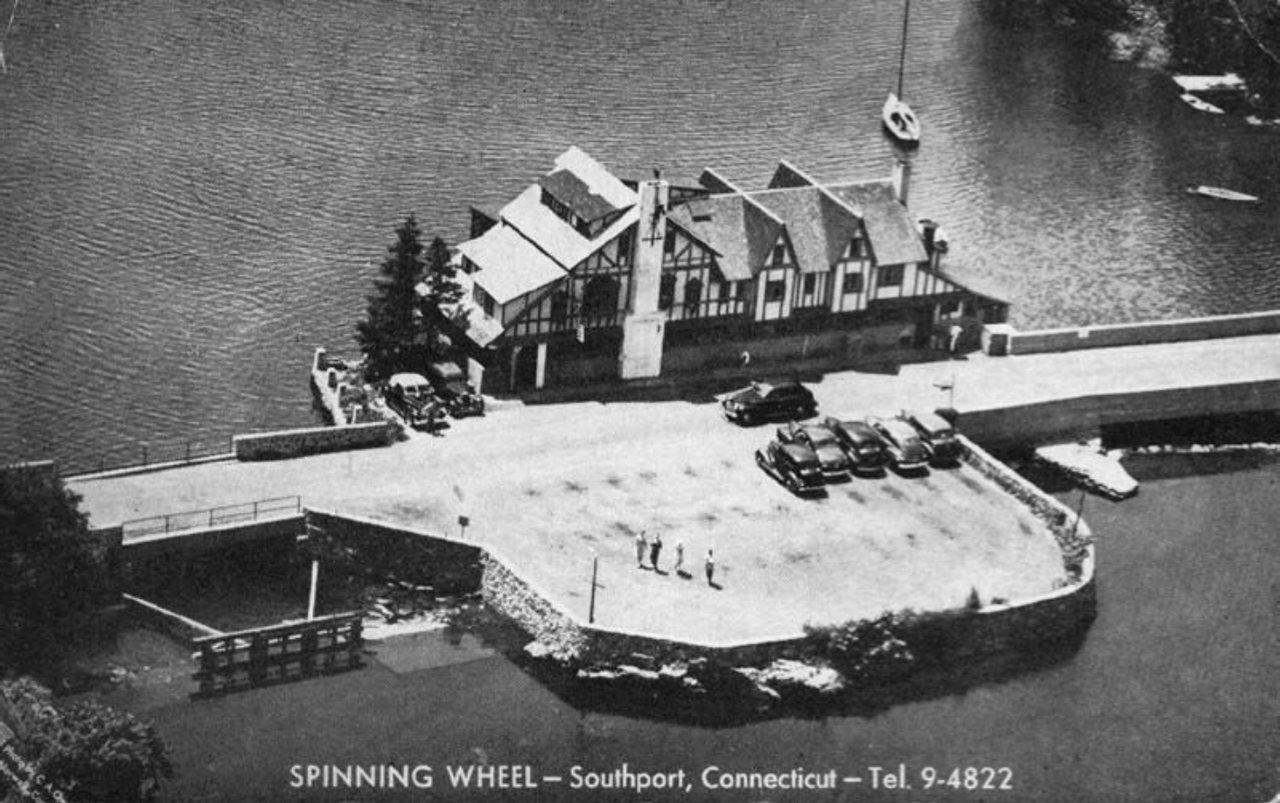
The Spinning Wheel

Mrs. Elaine D. Tottle and her son William, proprietors of the Spinning Wheel Inn at Redding Ridge, buy the building and rename it the Spinning Wheel Mill. The restaurant runs until 1955.

Aerial postcard of the Spinning Wheel restaurant at Southport, with cars parked beside the half-timbered building
The Spinning Wheel, Southport, in a mid-twentieth-century aerial postcard.
1957– 1960

A gift to the Boys’ Club

In 1957, John H. Ballantine of Greens Farms buys the building and, the same year, donates it to the Wakeman Memorial Association (the Wakeman Boys’ Club) to provide funds for its operations. The Galaske family runs the Tide Mill Inn Restaurant here until 1960, when the building is converted to offices — the use it has largely had ever since.

Part Five

A Southport Landmark

From restaurant to offices, historic district, and home.

1950s& after

Offices, and a home above the water

Dr. William Kueffner moves his pediatric practice to the Tide Mill Building in 1957 or 1958 (accounts differ). He later makes his home in the building’s top-floor “penthouse,” where he was living from 1986, according to a 2009 report. The building is sold in 1974. As it changes hands, its Tudor half-timbering is covered with vertical siding again, returning the old mill to something like its original appearance.

1971

On the National Register

The Southport Historic District is entered in the National Register of Historic Places in 1971. Its nomination lists the Tide Mill Building at 95 Harbor Road as the site of a grist mill from around 1722 until about fifty years earlier, and notes that its mill buildings had been incorporated into the present structure.

1982& 1992

Millstones underfoot, water at the door

In 1982 the Fairfield Citizen-News reports that the building’s entrance is still paved with some of the original millstone. In December 1992 a serious flood sends water into the building — knee-deep in the furnace room. Living on an island has its moments.

1997– 2005

A new bridge over the mill

In July 1997 the Fairfield Citizen-News revisits the Southport Tide Mill in a feature by Marcia Miner, noting that several old millstones can be seen behind the Fairfield Historical Society. That November, town boards begin discussing a replacement for the bridge connecting Harbor and Sasco Hill roads across the Mill River — a bridge in two spans, on either side of the building.

Construction begins in the fall of 2003 on a project originally projected at $2.4 million and later grown to about $3 million, reimbursable by state and federal grants. The work proves challenging — unexpected rock excavation, a severe winter, a collapsed cofferdam — and the bridge’s appearance sparks a long, spirited debate before the town’s Historic District Commission. In June 2005 the tenants are still waiting for it to finish, expected that November.

2009

Old mill, new energy

In October 2009 the town’s Historic District Commission approves solar panels for the Tide Mill roof, on a shallow, south-facing section the commission judged would not stand out from the dark roof. Dr. Kueffner had long been interested in alternative energy, and had also looked into generating power from the tide itself with a turbine — the same idea the mill’s builders put to work generations earlier.

2025November 4

A failed gate

The Town of Fairfield announces that a failed gate at the dam has caused occasionally lower water levels in the mill pond over recent months, and that the dam’s owner is working with the town and the state. To let fish migrate upstream and spawn, one of the flap gates would be installed so that it could be held open from March 15 to June 15 each year. The rest of the year, closed gates would bring back historically typical water levels.

The Next Chapter

The Dam Needs Us Now

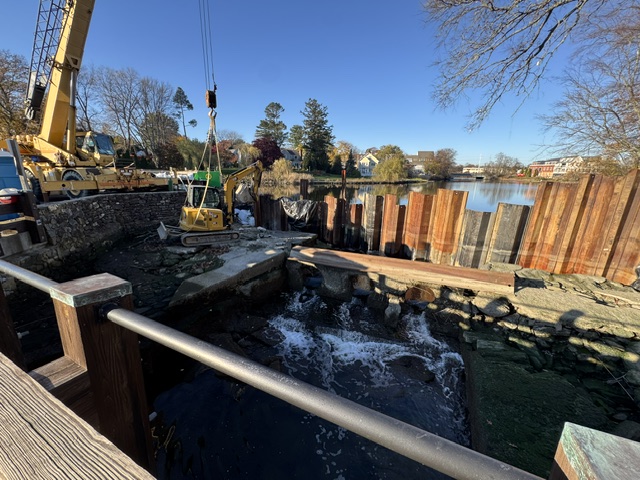
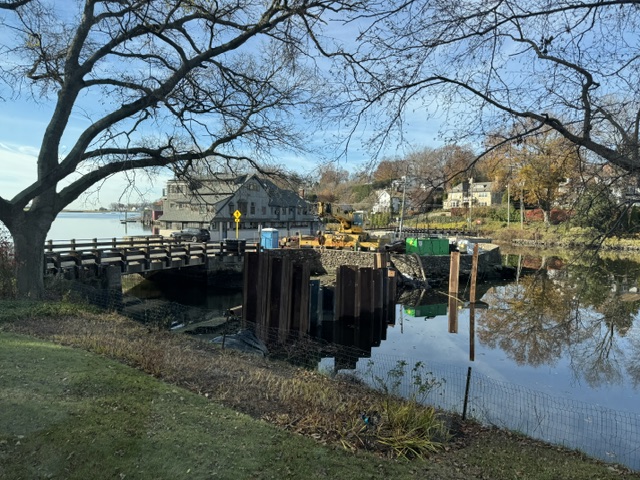
The town authorized a dam here in the 1720s, and for generations the historic Tide Mill Dam has regulated the flow of water from the Mill River into Southport Harbor. Years of disrepair — worsened by the ice floes of winter 2025/2026 — have dropped water levels and let sediment accumulate. Restoring this historic structure is the Mill River Estuary Foundation’s first and most urgent undertaking.

An excavator and crane working beside the Tide Mill Dam, with steel sheet piling along the far bank
Restoration work at the dam.
Steel sheet piling in place at the Tide Mill Dam, with the bridge and Southport Harbor beyond
Steel sheet piling in place, with the bridge and harbor beyond.

Sources

This history is drawn from documents gathered by the Foundation and from published sources:

Where our sources disagree, we have tried to say so. Do you have a photograph, document, or family memory of the Tide Mill? We would love to hear from you at [email protected].